


Hot Tub Rash FAQs
What causes hot tub rash?
Hot tub rash usually comes down to one of six things:
- Imbalanced water — low pH or low alkalinity makes water acidic, which can irritate skin on its own
- Chemical intolerance — some people are sensitive to chlorine, bromine, or non-chlorine shock, and react to the chemicals themselves
- Les bactéries — if sanitizer levels aren’t properly maintained, bacteria (including chlorine-resistant strains) can multiply and cause infection
- Sensitive skin — bathers with dry skin, eczema, or psoriasis are more likely to develop hot tub rash
- Medication — some medications, particularly certain heart medications, can cause a rash specifically while soaking in hot water; if you’re on medication and notice a rash, check with your doctor
- Hot water itself — some people have an intolerance to hot water alone, with no other cause involved
Can chlorine or bromine cause hot tub rash?
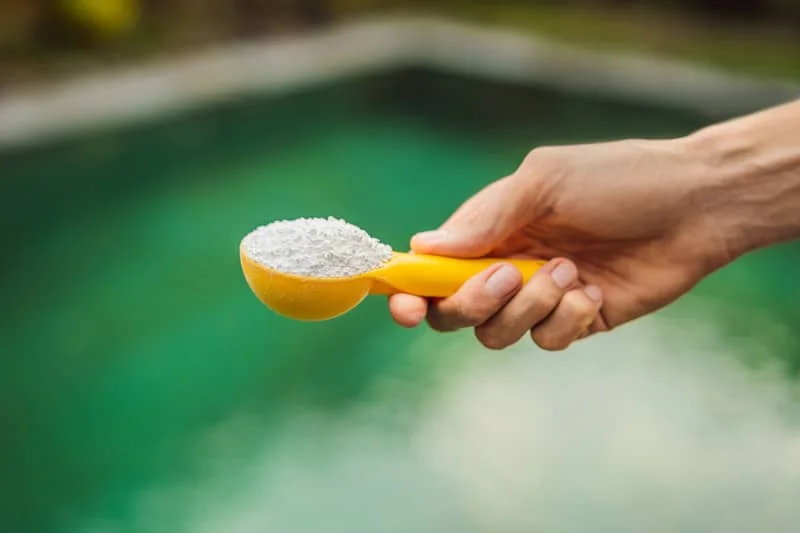
Yes — some people have a genuine intolerance to common spa sanitizers like chlorine, bromine, and non-chlorine shock (potassium monopersulfate). If you react to chlorine in other pools and spas, or can’t shower in cities with high municipal chlorine levels without a reaction, you may have a chemical intolerance. You can test this with the “Band-Aid test”: mix the chemical at the same ratio you’d use in your spa, moisten a Band-Aid pad with a sample, apply it to your skin for 2 hours, then check for a reaction. If you’re intolerant to one sanitizer, switching to another (chlorine instead of non-chlorine shock, or bromine instead of chlorine) is often enough to resolve it.
What is hot tub rash, exactly?
“Hot tub rash” is the common name for a skin reaction — usually itchy, red bumps — caused by using a hot tub or spa. It has several possible causes, including imbalanced water, chemical intolerance, and bacteria, but when it’s specifically an infection of the hair follicles caused by the bacteria Pseudomonas aeruginosa, it’s medically known as hot tub folliculitis, or Pseudomonas folliculitis.
How can I prevent hot tub rash?
- Maintain water balance — total alkalinity 80–150 ppm, pH 7.2–7.8 (7.2–8.4 if using Spa Marvel Water Treatment & Conditioner). Spa Marvel supports water balance by greatly decreasing the ongoing need to adjust pH and alkalinity, helping you avoid the acidic, imbalanced conditions that commonly cause hot tub rash.
- Reduce harsh chemical use — Spa Marvel clears the path for chlorine or bromine, allowing it to work much more efficiently, so it takes significantly less sanitizer to maintain your desired levels than without it.
- If you’re intolerant to a specific sanitizer, try switching — for example, use chlorine instead of non-chlorine shock, or bromine instead of chlorine, and vice versa. Different people react to different sanitizers, so finding one you tolerate can resolve the issue directly.
- Follow your local regulatory agency’s guidelines and use sanitizer as required, to prevent the bacterial growth that can cause hot tub rash and infection
- If you have sensitive skin, eczema, or psoriasis, Spa Marvel can help in two ways: it reduces the amount of harsh chemicals in the water, and will condition the water for sensitive skin, leaving skin feeling silky and soft rather than drying it out
- If you’re on medication and notice a rash after soaking, check with your doctor — some medications, particularly certain heart medications, can trigger a reaction specifically when soaking in hot water
- If you’re sensitive to hot water itself, lower the water temperature to 98°F or below, use the spa for shorter durations, and take a cool shower afterward
- Shower before entering and immediately after exiting — wetting your skin and hair beforehand reduces how much chlorine they absorb, and showering right after rinses off chlorine residue. Apply moisturizer while your skin is still damp
What is hot tub folliculitis, and how is it different from regular hot tub rash?
They’re closely related, not entirely separate conditions. “Hot tub rash” is the general, common term for any skin reaction from hot tub use. “Hot tub folliculitis” (also called Pseudomonas folliculitis) is the more specific, clinical term for one particular cause: an infection of the hair follicles by the bacteria Pseudomonas aeruginosa, which thrives in warm water when sanitizer levels aren’t properly maintained. So folliculitis is a type of hot tub rash, specifically the bacterial-infection kind, rather than a different condition altogether.
Peut-on attraper une éruption cutanée à cause d’un spa?
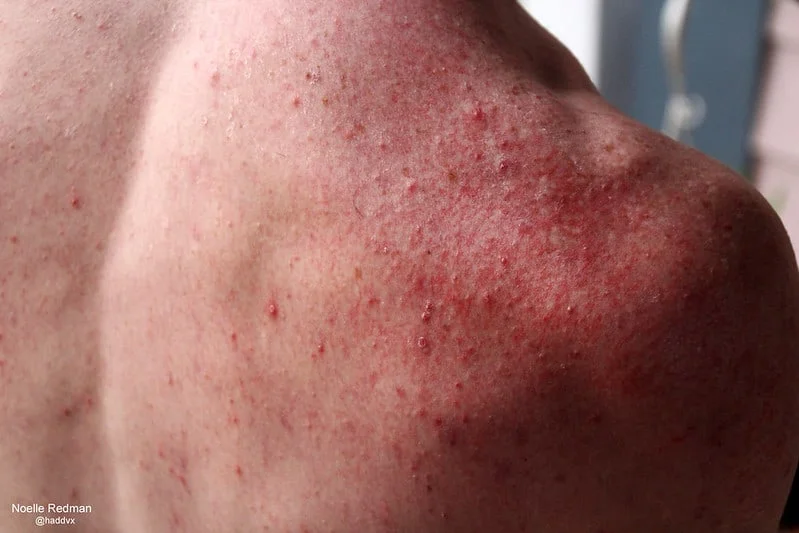
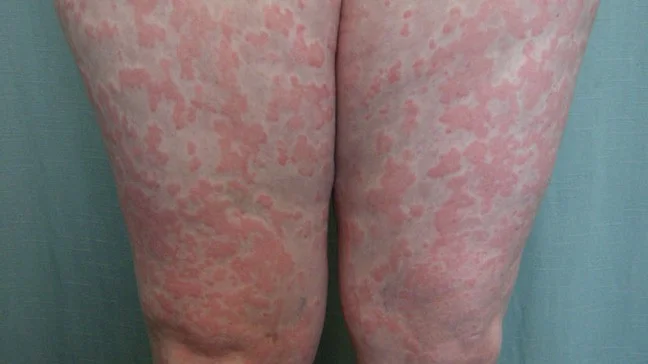
Hot tub rash can look different depending on the cause. The bacterial type (hot tub folliculitis) typically appears as itchy, red bumps around the hair follicles — these may be filled with pus and can resemble acne, chickenpox, or razor bumps. Chemical rash from chlorine or bromine looks different: it’s a type of irritant dermatitis that typically appears shortly after getting out of the water, causing skin that’s dry, red, itchy, and irritated rather than distinct bumps — though in some cases, hives can develop, which is worth mentioning to a doctor since it can point to a true allergic reaction rather than simple irritation. Hot tub rash is most common on skin that was covered by a swimsuit, since damp fabric holds contaminated water against the skin longer. See our Éruption cutanée causée par l’utilisation d’un spa : remèdes et photos article for photos of both types.
What does hot tub rash look like on kids?
The bacterial type (hot tub folliculitis) looks the same in children as in adults — small pink bumps that progress to raised, sometimes pus-filled bumps, most commonly clustered in the area covered by a swimsuit. It typically clears up on its own within 5–10 days and heals without scarring. Chemical rash from chlorine or bromine can also affect children and looks the same as it does in adults — dry, red, irritated skin rather than distinct bumps.
A few things worth knowing specifically for kids: children may be somewhat more susceptible than adults, since their immune systems are still developing and they tend to swallow more water. Siblings exposed to the same hot tub can also develop rashes of different severity from each other, even from the same exposure. Because hot tub folliculitis is less well recognized in pediatric care than in adults, it’s sometimes mistaken for a more serious infection — mentioning recent hot tub or pool use to your pediatrician can help them reach the right diagnosis quickly, and current research indicates the condition is generally mild and self-limiting in otherwise healthy children, without needing antibiotics.
How long does hot tub rash last?
How long it takes to clear up depends on which type you have. The bacterial type (hot tub folliculitis) typically clears up within 5–10 days, and it’s worth seeing a healthcare provider if it hasn’t resolved after two weeks. In rare cases, it can leave temporarily darker patches of skin (hyperpigmentation) that fade over time. Chemical rash from chlorine or bromine resolves much faster — typically within a couple of hours to a day or two after exposure, since it’s a surface irritation rather than an infection; contact a healthcare provider if it hasn’t improved within a couple of days.
Does hot tub rash go away on its own?
In most cases, yes. “Hot tub rash” usually refers to one of two different conditions, and both tend to resolve without medical treatment:
- Bacterial hot tub rash (folliculitis) — caused by Pseudomonas aeruginosa bacteria — typically clears up on its own within one to two weeks.
- Chemical rash (chlorine or bromine rash) — an irritant reaction to hot tub chemicals rather than an infection — usually clears up faster, often within just a few days once you’re away from the irritant.
Either way, if the rash worsens, spreads, or is accompanied by a fever, it’s worth calling a healthcare provider, since this can point to a more significant infection.
For a full breakdown of both types and how to tell them apart, see our Complete Guide to Hot Tub Folliculitis. Traitement de l’eau & conditionneur de Spa Marvel helps prevent both types: its enzymes break down the organic matter that sanitizer would otherwise have to work through, clearing the way for the sanitizer to disinfect more efficiently. That means less sanitizer is needed to keep bacteria like Pseudomonas aeruginosa in check — reducing the risk of folliculitis — while also cutting down on the chemical exposure that causes chlorine or bromine rash in the first place.
Is hot tub rash contagious? Can it spread to other people?
No — this applies to both the bacterial type (hot tub folliculitis) and chemical rash from chlorine or bromine, though for different reasons. Hot tub folliculitis isn’t contagious between people. However, if you and others were in the same contaminated hot tub, you may develop the same rash around the same time, since you were all exposed to the same bacteria in the water. Chemical rash is not contagious either, but for a completely different reason — it’s not an infection, just skin irritation from contact with the chemical itself, so there’s nothing biological involved that could spread to anyone else.
Is hot tub rash dangerous? When should I see a doctor?
Most cases are mild and resolve without treatment, but the bacterial type (hot tub folliculitis) and chemical rash from chlorine or bromine can both become a real issue if untreated. For hot tub folliculitis, see a healthcare provider if the rash persists beyond two weeks or worsens, or if you develop a fever, nausea, or vomiting — people with weakened immune systems should be especially cautious, since the same bacteria can occasionally cause more serious infections, including pneumonia in people with cystic fibrosis. For chemical rash, call a healthcare provider if the rash doesn’t go away, or gets worse, within a couple of days — if it’s still hanging around after that, it’s less likely to actually be a simple chlorine reaction and may need a proper diagnosis.
What are the symptoms of hot tub rash — is it itchy?
Yes, itching is a primary symptom for both types. Hot tub folliculitis (the bacterial type) causes itchy red bumps around the hair follicles, sometimes filled with pus, and some people also experience nausea, vomiting, or a sore throat alongside the skin symptoms. Chemical rash from chlorine or bromine feels different — it’s a form of irritant dermatitis causing dry, red, itchy, irritated skin rather than distinct bumps, though hives can occasionally develop, which is worth mentioning to a doctor since it can point to a true allergic reaction rather than simple irritation.
Is hot tub rash the same as chickenpox? How can I tell them apart?
No, they’re different conditions. Folliculite du spa (the bacterial type) is the one that can look similar to chickenpox, especially early on — it roughly resembles chickenpox at first, then develops further into more pimple-like bumps. Chemical rash from chlorine or bromine looks quite different from both — dry, scaly, red irritation rather than distinct bumps — so it’s not typically confused with chickenpox. The clearest ways to tell hot tub folliculitis apart from chickenpox:
- Cause: hot tub folliculitis is a bacterial infection (Pseudomonas aeruginosa); chickenpox is a viral infection caused by the varicella-zoster virus
- Contagion: chickenpox spreads easily person-to-person through airborne droplets and contact; hot tub folliculitis does not spread between people
- Location: hot tub folliculitis typically concentrates under areas covered by a swimsuit; chickenpox usually starts on the face, chest, or back and spreads across the whole body
- Timing: hot tub folliculitis appears within 1–2 days of exposure to contaminated water; chickenpox has a longer incubation period of 10–21 days and isn’t tied to water exposure
- Accompanying symptoms: chickenpox typically comes with fever and small fluid-filled blisters that crust over; hot tub folliculitis bumps are more likely to be pus-filled without the same blistering pattern
If you’re unsure which you’re dealing with, especially in a child, a healthcare provider can distinguish them quickly.
Is hot tub rash the same as bed bug bites?
No, they’re different conditions with distinct patterns. According to the CDC, bed bug bites appear as a slightly swollen, red, itchy area, with bite marks that may be random or appear in a straight line — they typically show up on exposed skin like the arms, neck, or face, since bed bugs feed at night while you sleep, and marks can take anywhere from a day to two weeks to appear. Hot tub folliculitis, by contrast, causes itchy red bumps around the hair follicles, which may be filled with pus, and can develop from hot tubs, swimming pools, water parks, and other warm, moist environments — it’s most common in areas covered by a swimsuit rather than generally exposed skin, appearing within a day or two of exposure rather than after a night’s sleep. If your bumps are in a straight line on skin you sleep with exposed, bed bugs are more likely; if they’re clustered under your swimwear after recent hot tub or pool use, hot tub rash is more likely.
How do you treat hot tub rash?
Treatment depends on which type you have, and ranges from simple home care to prescription medication depending on severity. For hot tub folliculitis (the bacterial type), mild cases can often be managed with home care alone, though more serious or recurring infections may need a prescription cream or oral antibiotics. For chemical rash from chlorine or bromine, most cases respond well to over-the-counter creams and simple self-care, without needing a doctor’s visit at all. Both types are usually mild and resolve within one to two weeks. See a doctor if hot tub folliculitis persists beyond two weeks, worsens, or comes with fever, nausea, or vomiting, or if chemical rash doesn’t improve within a couple of days.
What are effective home remedies for hot tub rash?
For hot tub folliculitis (the bacterial type), apply a warm, moist washcloth or saltwater compress to the affected skin, wash with an antibacterial cleanser, and shower and change out of your swimsuit right after getting out of the water. For chemical rash from chlorine or bromine, a cool compress and a rich, unscented moisturizer can ease irritation, and a colloidal oatmeal bath is a soothing alternative if you want to soak without getting back in chlorinated water.
What cream or medication helps with hot tub rash?
For hot tub folliculitis, a doctor may prescribe silver sulfadiazine cream, applied twice a day, or white vinegar soaks for the affected area; severe or resistant cases may need oral antibiotics. For chemical rash, hydrocortisone cream, aloe vera, or calamine lotion can relieve irritation. Talk to a doctor or pharmacist before starting any of these, since the right choice depends on your specific symptoms and history